


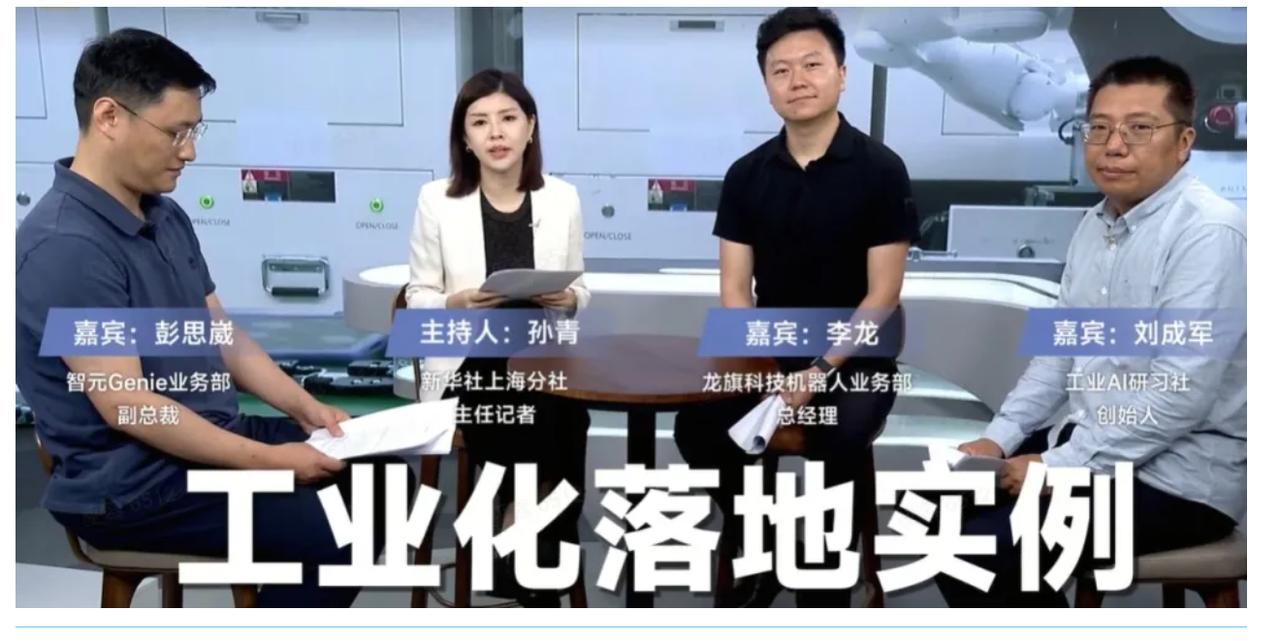
On July 2, CCTV's "Economic Half-Hour" aired a segment titled "Robots: From Show Floor to Shop Floor," turning the spotlight on Longcheer Technology's manufacturing center in Nanchang, Jiangxi. The program followed "robot quality inspectors" through every stage of their real-world journey — from initial onboarding and calibration to full deployment on the production line. It offered an inside look at how investment in production-line automation is putting intelligent robotics to work, and how these systems are delivering measurable value to smart manufacturing systems.
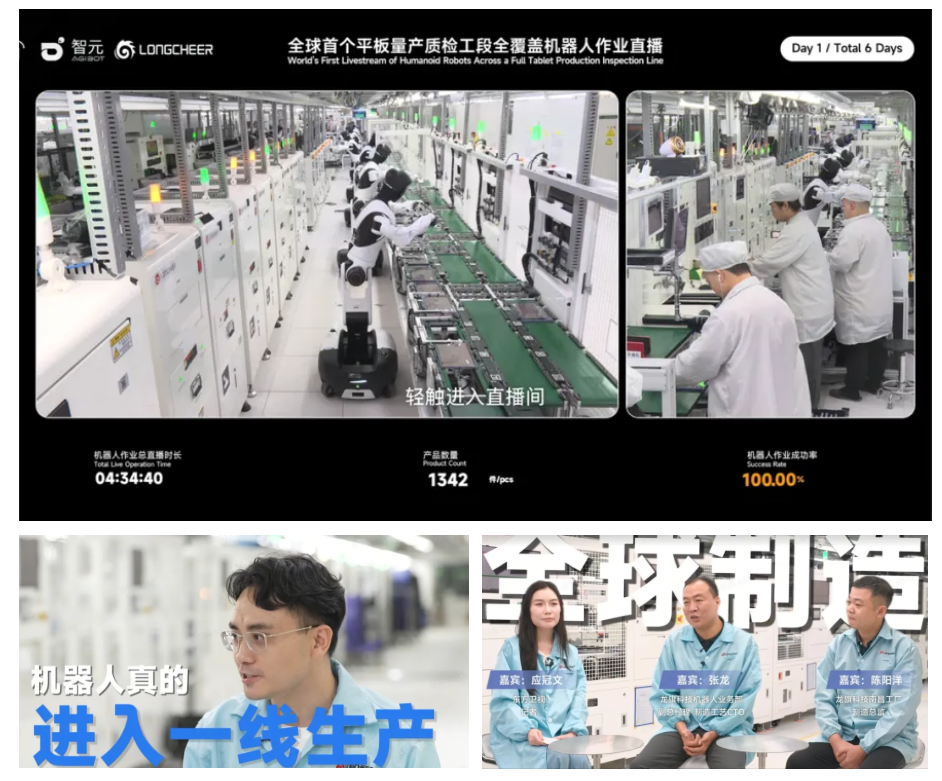
Just days before the broadcast, from June 23 to 28, a fully transparent production-line livestream took place at the same Nanchang facility—6 days, 64 hours, 8 AgiBot Lingxi G2 units. This was the first long-duration livestream in China’s 3C manufacturing industry covering a full workstation segment with multiple humanoid robots working collaboratively.During the stream, the eight robot "workers" were fully embedded in the production workflow, taking on highly repetitive and physically demanding tasks—including pick-and-place, transfer, and sorting—at the tablet testing stage, with zero interruptions across the entire run. This wasn't a showcase of isolated capabilities; it marked the first full validation of factory-scale deployment, proving Longcheer’s embodied AI tech has entered a new phase built on stable deployment, nonstop operation and replicable mass rollout.
From Point Validation to Workstation-Closed-Loop: Longcheer's Smart Manufacturing System Capabilities Take a Step Forward
rom April to June, the evolution was clear: from a single workstation to full-process coverage of the tablet quality inspection segment; from four intelligent terminals to an eight-unit coordinated cluster; from eight-hour single-day runs to 64-hour continuous operations. Under real order pressure, Longcheer's Nanchang Manufacturing Center independently executed multiple high-precision inspection tasks—including multimedia interface testing, audio testing, radiated interference testing, and coupling testing—achieving a 99.99% operational success rate.
According to Li Long, General Manager of Longcheer's Robotics Business Unit: "The key advancements in this livestream demonstration can be summarized in three dimensions. First, coverage—we've progressed from a single workstation to a closed-loop segment, moving from 'proof of concept' to full-segment coverage. Second, coordination—we've evolved from a single unit to a coordinated cluster, with task scheduling, cycle-time synchronization, and exception recovery now forming a complete closed loop. Third, replicability—we've extended from short-term validation to 64-hour long-cycle stable operations, with our operations and maintenance systems passing the test of real production conditions."
What this livestream truly validated goes far beyond whether a single terminal can perform a specific task—it tested the comprehensive capabilities of an entire manufacturing system. Overall, replicability has been significantly enhanced, laying the groundwork for scaling deployment in the future. This is precisely the core competitive capability that Longcheer—as a technology company providing end-to-end smart product services—needs as it continues to upgrade its manufacturing capabilities.
Forging Industrial-Grade Reliability on Real Production Lines to Drive Smart Manufacturing Upgrades
production lines, and to continuously tackle challenges head-on through joint efforts with partners, is rooted in the company's long-term strategic planning for its future smart manufacturing capabilities.
The 3C industry is defined by rapid product cycles, tight delivery schedules, and fragmented orders—all of which demand greater manufacturing flexibility.
According to Li Long, "Traditional automation equipment and embodied robots can work together to improve overall production efficiency. Traditional automation systems are rigid and fast in cycle time, while humanoid robots are better suited to existing manual workstations and can be flexibly redeployed across different stations."In fact, during the early stages of the robot deployment, the biggest challenge for the joint task force from Longcheer and AgiBot wasn't getting a robot to perform a specific action—it was navigating the countless "unavoidable real-world variables" that emerged once they moved into the actual factory: communication with existing automation equipment, upstream and downstream cycle-time alignment, exception-handling logic, and safety boundaries—all of which simply don't exist in simulations or lab environments.
Yang Chun, who leads the joint algorithm team within Longcheer's Robotics Business Unit, put it bluntly from a factory acceptance perspective: "At the end of the day, the factory only cares about two things: can it run, and can it keep running." In other words, safety, stability, cycle-time consistency, and fault recoverability are the hard metrics that Longcheer must invest in and master. Beyond that, what Longcheer values most is not just a robot's current motion capabilities, but the underlying technical potential for learning, self-adaptation, and autonomous analysis and decision-making—continuously pushing the boundaries of smart manufacturing while building real-world deployment experience along the way.
Today, the strength of China's robotics industry lies in the convergence of technology, supply chains, application scenarios, and engineering capabilities. Competitiveness isn't built by waiting for the perfect generalized solution before entering the field—it's forged by achieving industrial-grade reliability in specific, real-world use cases first. For Longcheer, robots are more than just tools for replacing repetitive labor—they are a critical enabler for building the automated and autonomous factories of the future. No matter how end-device form factors evolve, Longcheer's focus remains clear: use real production lines as the testing ground, stable operations as the baseline, and replicability and scalability as the ultimate goal—steadily advancing its smart manufacturing transformation.
The "Deployment-State" Era Has Arrived: Longcheer Is Moving Forward with Continuous Iteration
2026 is widely regarded as the inaugural year of embodied AI moving into true "deployment-state." The 6-day, 64-hour livestream demonstrated that the initial phase of human-robot collaboration has already achieved its goals: multiple robots, operating as a stable unit, are now embedded on the production line, handling repetitive, standardized tasks such as pick-and-place, transfer, and sorting. Human workers oversee inspection, coordination, exception handling, and floor management.
The next phase will push into more complex, high-value scenarios—flexible loading and unloading, material transport, assisting human-operated workstations, and packaging—allowing the team to test the generalizability and cost-effectiveness of embodied AI across a broader range of real-world factory applications.
Looking ahead, Longcheer has charted a three-pronged roadmap: deepen existing use cases—expanding from single workstations to full production segments; broaden into new applications—tackling high-value processes such as packaging, visual inspection, and precision assembly; and strengthen core capabilities—integrating domain expertise, manufacturing know-how, and delivery excellence to serve a wider base of industrial customers globally. While there is still room for technological iteration before we reach large-scale deployment, for Longcheer, every effort in capability-building is aimed at one goal: delivering more stable, efficient, and flexible manufacturing services to our customers. As robots transition from "demo mode" to true "production mode," Longcheer will respond to every customer's expectation for quality and efficiency with more reliable, full-system capabilities.