


On April 14, Longcheer Technology conducted a live broadcast of a humanoid robot production line operation at its Nanchang factory. This marked the first public demonstration of Longcheer, as an industry partner, in jointly developing and advancing embodied intelligence from technical validation to industrial application. Since forming a strategic partnership with AgiBot in October of last year, Longcheer has been committed to the goal of "co-creating new productive forces," selecting an open mass-production line scenario to allow embodied robots to optimize their practical operations under real production pressure. This eight-hour live broadcast also signified Longcheer's transformation from a "technology user" to a "capability co-creator."
In the joint effort to bring embodied intelligence from the lab to the production line, Longcheer deeply participated in collaborative R&D. From project initiation in October 2025 to passing POC acceptance in early 2026, Longcheer completed the entire process validation from solution design to line integration within just a few months.
Unlike the conventional "procure-deploy" model, deploying Longcheer's Nanchang tablet mass-production line as a validation scenario provided AgiBot's robots with a genuinely high-pressure production environment for debugging. In this live broadcast, fully supported by Xinhua News Agency's media, the robot, G2, was performing pre-shipping testing tasks for tablets. This type of work involves repetitive, monotonous, and high-intensity cyclical operations. The initial expectation for robot substitution was to free employees from such fatigue-prone positions and enable them to upgrade their skills for more technically demanding roles. This task requires not only precisely grasping tablets from a high-speed moving conveyor belt and accurately placing them into corresponding test fixtures but also real-time communication with the testing equipment. After testing, the robot sorts finished and non-conforming products and returns them to the conveyor belt via information exchange. Embodied robots combine stability, efficiency, precision, and generalization, offering self-learning and flexible manufacturing capabilities, as well as acting as intelligent agents for real-time data processing. After finalizing the solution, the two teams formed a joint on-site team for collaboration. Longcheer injected over 20 years of precision manufacturing experience and supply chain capabilities into the project, providing real-world industrial input for technological iteration—from production line layout and process standards to cycle time requirements and exception handling, feeding back manufacturing needs.
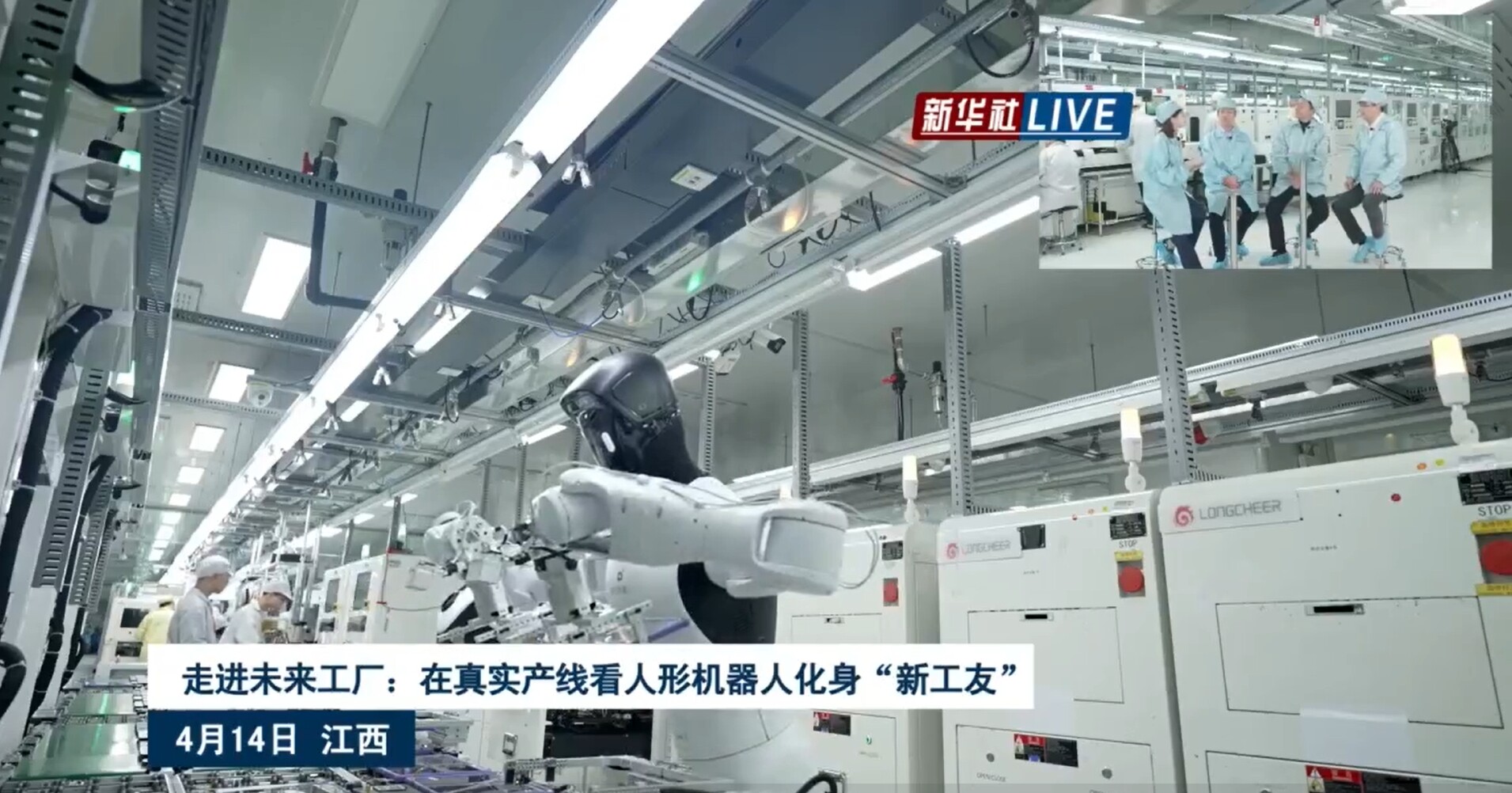
The AgiBot team focused on the technical aspects, endowing the G2 with human-like real-time perception and decision-making capabilities. Through "eyes" that detect slight fixture offsets, a "brain" that performs millisecond-level dynamic path planning, and "hands" with high-sensitivity force sensors for precise operations, they advanced the production line's process customization capabilities toward a flexible, rapid modular deployment approach.
When answering the Xinhua News Agency reporter's question,“Why choose a robot for this manufacturing process?” The head of Longcheer's Embodied Intelligent Robot Application Project explained: "To achieve better manufacturing process management, we have deployed many systems as safeguards. However, issues such as information gaps between systems, interconnectivity, real-time monitoring, and the prediction, analysis, and decision-making required for future smart manufacturing all demand a supporting platform that can aggregate information and provide computational power. Therefore, after evaluating the technical challenges, we identified this as one of many scenarios where robot intervention is suitable. The current motion time on our production line has significantly improved compared to the lab stage, exceeding our expectations. In terms of stability, from March 16 until now, the robot has been integrated into the main line, operating continuously for over 10 hours per day on average, accumulating over 200 hours of continuous operation, with a downtime loss rate of only 4%. This indicator has also exceeded our expectations." It can be said that compared to traditional automation equipment, which struggles to flexibly respond to product changeovers, positional deviations, or spatial interferences, the robot can form a minimal working unit with testing equipment and conveyor tracks, collaborating interactively to achieve a transition from "fixed programming" to "flexible adaptation" on a real production line.
Yao Maoqing, Partner, Senior Vice President, and Head of the Embodied Business Unit at AgiBot, stated: "The results of this joint R&D have broken through the operational barriers of embodied intelligence in high-speed production line scenarios, completing the industry's first full technical closed-loop validation from simulation to real-machine deployment. It systematically achieves four core capabilities—scene generalization, instruction generalization, action generalization, and task generalization—efficiently empowering standardized scenarios in production and manufacturing, realizing the complete loop of 'online data collection – cloud-based model training – edge-side inference and execution.'"
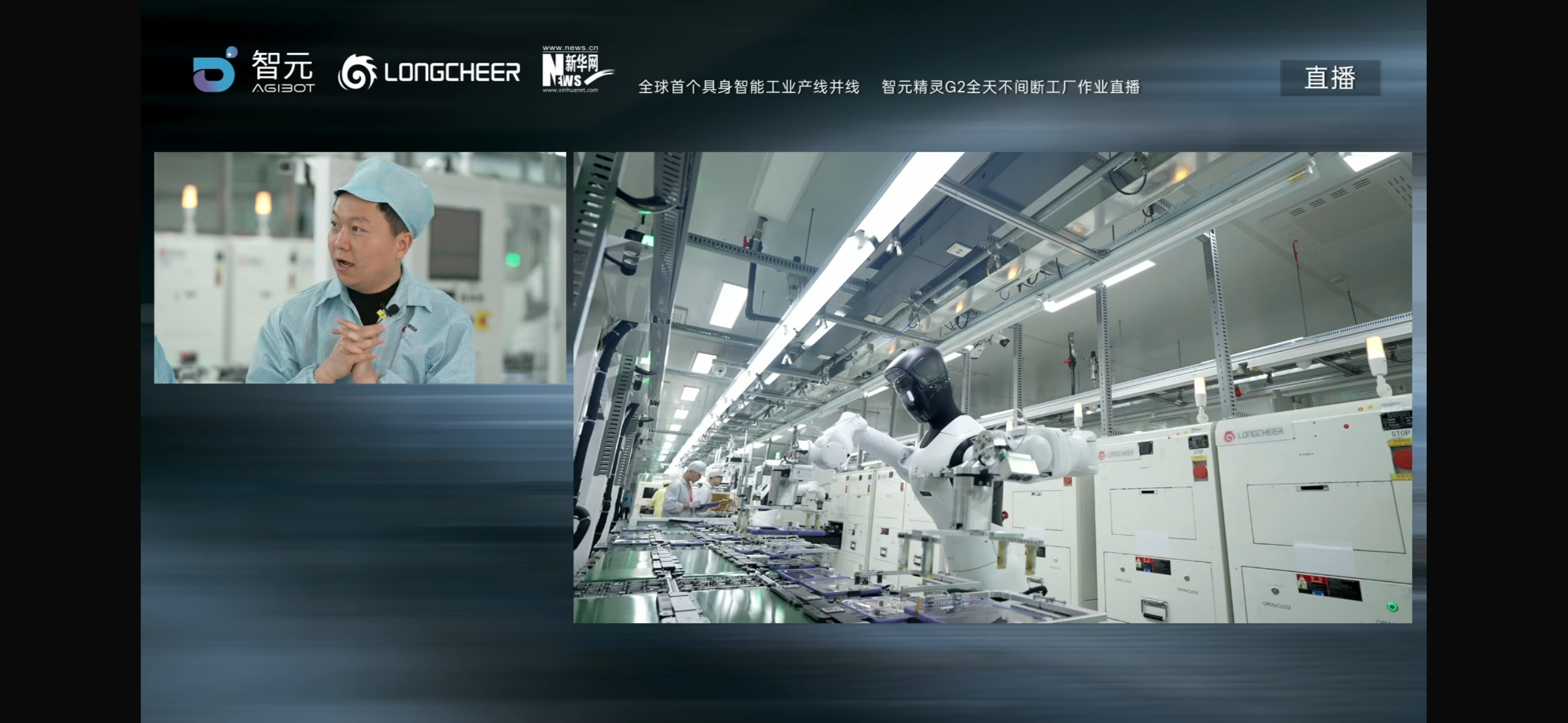
Through the joint R&D with AgiBot, Longcheer continues to accumulate and strengthen its capabilities in manufacturing core components and complete machines, gradually moving from "using robots well" to "building good robots." As Li Long, General Manager of Longcheer's Robotics Business Unit, remarked, "Longcheer's partnership with AgiBot is not about purchasing a robot but about co-creating a new form of productive force. The intelligent transformation of manufacturing requires technological breakthroughs as a prerequisite, but what truly determines the speed and success of implementation is the willingness to open up a real production line, allowing robots to evolve alongside frontline teams under extreme pressure. Testing and material handling is just the first battle. Next, we will tackle packaging, appearance inspection, precision assembly—moving from a single workstation to entire production line segments. Our goal this year is to deploy multiple scenarios, step by step expanding the front lines of embodied intelligence. We believe that the continuously improving cross-scenario transfer and generalization capabilities of general-purpose embodied intelligent robots will build a more competitive smart manufacturing system."